Computational Neuroscientist & Research Engineer
Pipelines, statistical frameworks, multi-scale analysis — built to answer questions that don't have off-the-shelf methods. Engineer first. Neuroscientist by choice.
Computer engineer turned neuroscientist. I discovered my passion for neuroscience while working at a medical device company during COVID-19 — following a spark of curiosity left by a traumatic brain injury. To transform one of the worst things that happened to me into one of the best things that happened for me.
That decision led me to one of the only MS programs in Cognitive Neuroscience in the United States — and to mapping what happens to the brain's neurovascular system after moderate-to-severe TBI.
My MS thesis produced one of the first vertex-based CBF-fALFF neurovascular coupling analyses in TBI — 20,484 cortical points per person, 63 subjects (29 TBI + 34 controls), three timepoints, two spatial scales: global (whole-brain and hemisphere-level) and neighbourhood vertex-wise coupling. Submitted January 2025. 150+ downloads across 10 countries before journal publication. Presented at RCMI 2025.
As Research Associate I expanded this work substantially across three fronts. First, extended the preprocessing pipeline — identifying that standard motion thresholds were insufficient for TBI populations and implementing validated TBI-appropriate scrubbing parameters, with stricter lesion masking. Second, built two categories of automation: parallel processing scripts running multiple subjects simultaneously through FreeSurfer, and end-to-end analysis scripts that made the manuscript-scale work tractable. The thesis computed global coupling for 2 values per subject — LH and RH — manually in Excel: coupling columns, T-tests, corrected p-values, box plots, one subject at a time. The manuscript extends this to five simultaneous spatial scales across 139 subjects: 68 DKT atlas regions × 2 hemispheres, 7 Yeo networks × 2 hemispheres, neighbourhood vertex-wise, whole-brain, and hemisphere-level. At that scale FDR correction must run across all regions simultaneously, and every figure regenerates automatically when the data changes — neither is possible to do correctly by hand. Third, documented the full pipeline so a neuroimaging novice could replicate start-to-end from raw data. First-author manuscript in preparation.
TBI is where I built my proof of work. It is not the boundary of what I can do or think in. I am drawn to any hard problem at the intersection of how the brain works and how we build systems to understand or augment it — neuroimaging, BCI, human factors, computational methods applied to brain health. The engineering and scientific curiosity transfers and expands.
Disciplines were divided so it's easier to go deep — not that they're separate when seen from a higher dimension.
An expanded first-author study investigating CBF-fALFF neurovascular coupling disruption across the first year post-injury in moderate-to-severe TBI. Applies five simultaneous analytical frameworks — whole-brain global, hemisphere-level, Yeo-7 functional networks, 68-region DKT atlas, and neighborhood vertex-wise — to characterize disruption patterns and their relationship to injury severity (PTA), neuropsychological outcomes, and lesion volume. Built on my MS thesis, expanded in scope and depth through ongoing Research Assistant work.
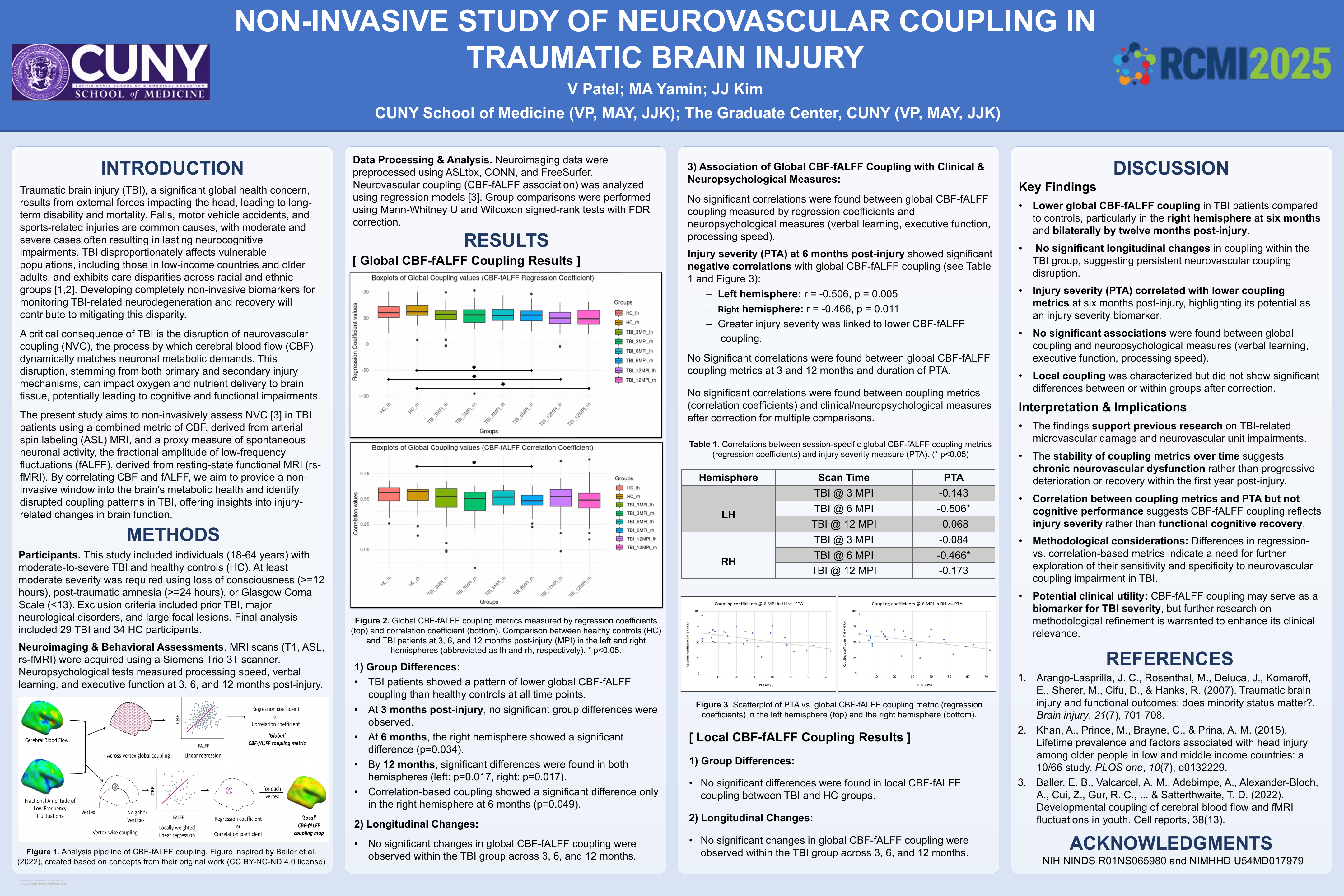
One of the first studies to examine neurovascular coupling in moderate-to-severe TBI at vertex-level spatial resolution. Computed CBF-fALFF coupling at 20,484 cortical surface points per subject across 121 imaging sessions (29 TBI × 3 timepoints + 34 controls). Found significant bilateral coupling disruption at 12 months post-injury and significant negative correlation between coupling and post-traumatic amnesia severity (PTA) at 6 months — supporting NVC disruption as a candidate non-invasive biomarker for TBI severity and recovery monitoring.
Presented at RCMI 2025. Co-authored with MA Yamin and JJ Kim (CUNY School of Medicine / Graduate Center). Examined CBF-fALFF neurovascular coupling in moderate-to-severe TBI — 29 TBI patients, 34 healthy controls, three timepoints. Found persistent hemisphere-level coupling disruption by 12 months post-injury and significant negative correlation between coupling and injury severity (PTA) at 6 months. Funded by NIH NINDS and NIMHHD.
Most job-search tools solve the wrong problem. They automate the application — bulk-apply, auto-fill, spray and pray. The actual bottleneck is upstream: figuring out which roles are worth your time, whether you're eligible to take them, what makes you the right person for this specific company's problem, and what you should be building toward that these roles are practice for. This system addresses all four. The operational layer (find, filter, comply, score, draft) handles execution. The strategic layer answers a harder question: given who you actually are, what work would be genuinely hard to replace you in?
Manual execution — I run each agent, read the output, decide what moves forward · every fit score cites specific JD language · fabrication guard in every resume prompt · judgment stays human throughout
Two tools built for the same research programme. The pipeline extends the standard ASLtbx workflow with a TBI-appropriate motion scrubbing stage — ASL is a low-SNR sequence where standard motion thresholds designed for healthy adults are insufficient for TBI populations who move more during scanning. Identifying this gap, adapting the thresholds to the population, and inserting a validated scrubbing stage between PART1 and PART2 was a methodological contribution, not a toolbox fix. The analysis scripts make the full scale tractable — the thesis computed global coupling for 2 values per subject in Excel: coupling columns, manual T-tests, corrected p-values, box plots. The manuscript extends this to five simultaneous spatial scales across 139 subjects: 68 DKT regions × 2 hemispheres, 7 Yeo networks × 2 hemispheres, vertex-wise, whole-brain, and hemisphere-level. At that scale, FDR correction has to run across all regions simultaneously — Excel can't do that correctly — and every figure would need to be remade by hand each time anything changed. A single script call now produces what would have required rebuilding that spreadsheet hundreds of times over.
Looking for roles in neuroimaging research, neurotechnology, healthcare AI, or academic research labs focused on brain health and recovery.
Research Scientist · Research Associate · Computational Neuroscientist · Data Scientist · Human Factors Scientist